Java Thread Pools
Creating multiple Threads in Java can have significant impact on the memory consumption and consequently on application performance.
Java Thread Pools provide a mechanism for managing and reusing a pool of worker threads, improving the performance and scalability of concurrent Java applications. A thread pool consists of a fixed number of threads that are created and maintained by the Java Executor framework. Instead of creating and destroying threads for each task, thread pools keep a set of idle threads ready to execute incoming tasks, reducing the overhead of thread creation and context switching.The Java Executor framework provides a high-level abstraction for working with thread pools. It offers several implementations of the Executor interface, such as ThreadPoolExecutor and ScheduledThreadPoolExecutor, that manage thread pools and handle task scheduling. These implementations provide configurable parameters, including the core pool size, maximum pool size, and thread keep-alive time, allowing developers to tune the thread pool according to the specific requirements of their application.
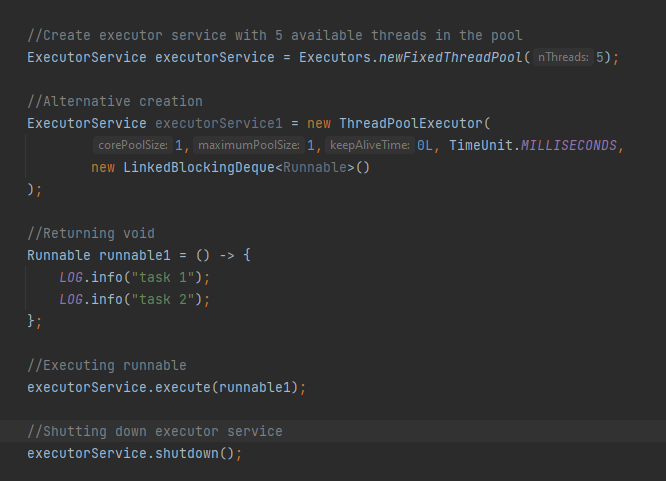
Creating an executor service and executing one runnable
Thread pools offer several advantages over manually managing threads. Firstly, they provide better control over the number of threads running concurrently, preventing resource exhaustion and improving system stability. The fixed-size nature of thread pools ensures that the number of active threads remains within bounds, avoiding excessive resource consumption. Additionally, thread pools can help manage the workload by queueing incoming tasks when all threads are busy, preventing task overload and potential performance degradation.
Thread pools also improve application performance by reusing threads. Creating and destroying threads incurs significant overhead due to the associated thread initialization and context switching. By reusing existing threads from the pool, this overhead is eliminated, resulting in faster task execution and improved overall throughput. Thread reuse also helps maintain thread-local data, such as thread-local variables or thread-specific configurations, throughout the execution of multiple tasks, preserving the integrity and consistency of such data.
Another advantage of thread pools is their ability to provide thread lifecycle management and fault tolerance. Thread pools can handle thread failures, such as unhandled exceptions or unexpected terminations, by replacing failed threads with new ones. This ensures that the pool always has the required number of active threads available for task execution, even in the face of thread failures. Furthermore, thread pools facilitate graceful shutdown of the application by allowing tasks to complete and preventing the abrupt termination of threads, ensuring that resources are properly released and application state is maintained.
In conclusion, Java thread pools are a powerful mechanism for managing and optimizing concurrent execution in Java applications. By providing a pool of reusable threads, thread pools reduce the overhead of thread creation, enhance system stability, and improve application performance.