Java Threads
Java Threads are a crucial aspect of concurrent programming in Java, allowing for the simultaneous execution of multiple tasks within a single program. Threads are lightweight units of execution that operate independently, enabling efficient utilization of system resources and enhancing the responsiveness and performance of Java applications. By dividing a program into smaller, independent units of work, threads enable tasks to be executed concurrently, potentially improving overall throughput and reducing latency.
In Java, threads can be created by either extending the Thread class or implementing the Runnable interface. Extending the Thread class provides more flexibility, allowing direct access to thread-related methods and properties. On the other hand, implementing the Runnable interface offers a more object-oriented approach, separating the task logic from the thread implementation. Thread objects can be created and started using the start() method, which initiates the execution of the thread's run() method. Each thread operates in its own execution context, with its own stack and program counter, enabling independent execution paths within a program.
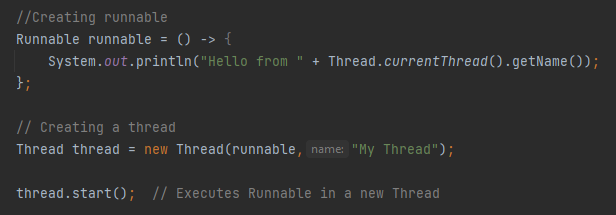
Creating a runnable and running it in a thread
Java provides various mechanisms for thread synchronization to ensure thread safety and prevent data corruption. Synchronization is crucial when multiple threads access shared resources concurrently, as it prevents race conditions and ensures proper data consistency. Java's synchronized keyword and intrinsic locks allow threads to coordinate their access to shared objects, ensuring only one thread can execute a synchronized block of code at a time. Synchronization can also be achieved using more advanced constructs like locks, semaphores, and condition variables, which provide finer-grained control over thread interactions and enable more complex synchronization patterns.
Java's threading model supports both thread-level and task-level parallelism. Thread-level parallelism allows multiple threads to execute simultaneously, leveraging the capabilities of modern multi-core processors. This enables faster execution of computationally intensive tasks by distributing the workload across multiple cores. Task-level parallelism, on the other hand, focuses on dividing a large task into smaller subtasks that can be executed concurrently. The Java Executor framework provides higher-level abstractions for managing thread pools and executing tasks asynchronously, simplifying the implementation of task-level parallelism and improving overall application performance.
Proper understanding and management of threads are essential for developing robust and efficient concurrent Java applications. Care must be taken to avoid common pitfalls such as deadlock, livelock, and resource contention. Thread safety should be ensured by using appropriate synchronization mechanisms, and shared data should be accessed and modified safely to prevent data corruption. It is also crucial to consider the potential impact on performance and resource utilization when using multiple threads, as excessive thread creation and contention can lead to decreased performance or even system instability. By mastering the principles of thread management, developers can harness the power of Java threads to create highly responsive, scalable, and efficient applications.